
Medically reviewed by Dr. Sathya Bharathwaj, MDS (Periodontics) • Updated July 2026
Blood in the sink after brushing is so common that most people stop noticing it. That normalisation is exactly why a bleeding gums periodontist will tell you the same thing every time: bleeding is never normal, and waiting is the single most expensive mistake in dental care. A healthy gum does not bleed, no matter how hard you brush. That single fact is worth repeating because most people were never told it, and it changes how seriously bleeding should be taken.
This article explains what bleeding actually means, why it is a warning rather than a minor irritation, and why seeing a bleeding gums periodontist early is so much cheaper and simpler than dealing with the same problem five years later.
Why gums bleed in the first place
Bleeding happens because the gum tissue is inflamed. Plaque – a soft film of bacteria – builds up along the gumline, and if it is not removed thoroughly, it hardens into tartar within days. The gum tissue reacts to this bacterial buildup by becoming inflamed, and inflamed tissue bleeds easily, even from something as gentle as flossing.
This early stage is called gingivitis, and it is entirely reversible. A professional cleaning and a genuine improvement in brushing and flossing can resolve it completely within a couple of weeks. This is the stage where a bleeding gums periodontist can fix the problem fastest and cheapest – which is exactly why catching it now matters so much.
Why bleeding is a warning sign, not a symptom to manage
Most people treat bleeding gums the way they treat a paper cut – as something minor that will heal on its own. Gum disease does not work that way. Left untreated, gingivitis progresses to periodontitis, where the inflammation moves from the soft tissue into the bone that holds your teeth in place.
Once bone is lost, it does not regenerate on its own. This is the single most important thing a bleeding gums periodontist wants every patient to understand: gingivitis is reversible, periodontitis is not. The window to fix this cheaply and completely is narrower than most people assume.
Bleeding gums are also linked to broader health. Research has connected untreated gum disease to increased risk in heart disease, diabetes control, and pregnancy complications. The mouth is not separate from the rest of the body, and chronic inflammation anywhere has consequences elsewhere.
Why the bleeding often stops on its own – and why that’s not good news
Here is the detail that catches most patients off guard. As gum disease advances, the bleeding sometimes reduces or disappears entirely. Patients understandably assume this means things have improved.
It usually means the opposite. As the disease progresses and blood supply to the area changes, the tissue bleeds less even though the underlying damage continues. A bleeding gums periodontist sees this pattern constantly – patients who stopped worrying the moment the bleeding stopped, only to discover years later that significant bone loss had already occurred silently in the background.
This is why the presence of bleeding matters less than most people think, and the absence of pain matters even less. Gum disease is largely a painless condition until it is very advanced.
What a bleeding gums periodontist actually checks
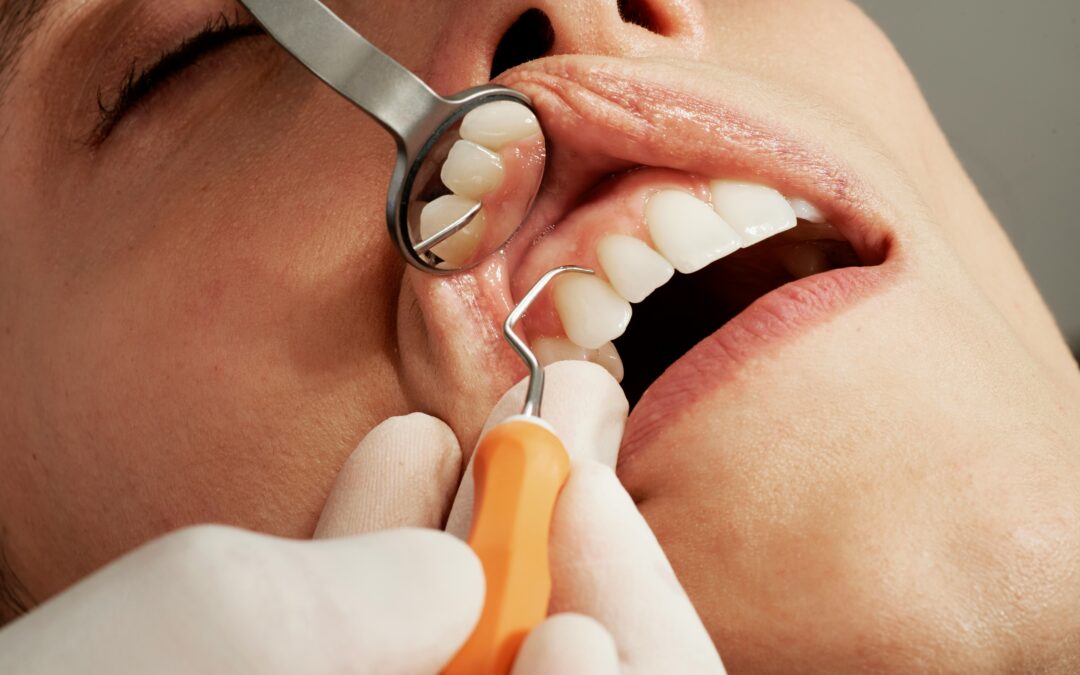
A proper periodontal visit is far more thorough than a routine cleaning, and takes roughly 20 to 30 minutes for the assessment alone.
- Pocket charting – a thin probe measures the depth of the space between gum and tooth at six points per tooth. Anything above 3mm needs attention; above 5mm typically needs active treatment.
- Bleeding on probing – whether the gum bleeds when gently probed, a more reliable indicator than bleeding while brushing.
- Full-mouth X-rays or a CBCT scan – to see bone levels that a visual exam and probing alone cannot reveal.
- Mobility testing – checking whether any teeth have started to loosen, which signals more advanced bone loss.
- A written treatment plan – staged and priced, starting with the least invasive option that will actually resolve the problem.
This is the difference between a general cleaning and an actual diagnosis. A bleeding gums periodontist is trained specifically to catch what a routine visit might miss, and the pocket chart from your first visit becomes the baseline every future visit is measured against.
What treatment actually looks like
Treatment depends entirely on how far the disease has progressed, and a bleeding gums periodontist will always start with the least invasive option that works.
Gingivitis (early stage): professional scaling and polishing, plus improved home care. Usually resolved within one to two visits and fully reversible.
Early periodontitis: deep cleaning, known as scaling and root planing, performed below the gumline in quadrants. Local anaesthesia is used, and most patients tolerate it very well.
Moderate to advanced periodontitis: laser-assisted treatment or flap surgery to access and clean deeper pockets, sometimes combined with bone grafting where bone has already been lost.
Maintenance, at every stage: gum disease is controlled, not permanently cured. A three to six month maintenance schedule after treatment is what keeps it from returning.
The earlier a bleeding gums periodontist sees you, the shorter and cheaper this list becomes.
What it costs to wait
Numbers make this easier to understand than warnings alone.
| Stage | Typical treatment cost |
|---|---|
| Gingivitis (early) | Rs.1,500 – Rs.3,500 for scaling and polishing |
| Early periodontitis | Rs.2,000 – Rs.4,500 per quadrant for deep cleaning |
| Moderate periodontitis | Rs.15,000 – Rs.30,000 for laser treatment |
| Advanced periodontitis | Rs.6,000 – Rs.35,000 per site for surgery and grafting |
| Tooth loss requiring implant | Rs.30,000 – Rs.60,000 per tooth |
A problem that costs a few thousand rupees to fix today can cost fifteen to twenty times more in five years, plus the loss of a natural tooth that no implant fully replaces. This is the entire argument for seeing a bleeding gums periodontist the first time you notice blood in the sink, not the tenth.
When to see a periodontist versus a general dentist
Mild, occasional bleeding that resolves with better brushing can often be managed by a general dentist. See a bleeding gums periodontist specifically if:
- Bleeding happens most times you brush or floss, not occasionally
- Gums look red, swollen, or have started to recede
- You notice persistent bad breath that brushing does not fix
- Any tooth feels even slightly loose
- A general dentist has already flagged pocket depths above 4-5mm
- You have diabetes, which significantly worsens gum disease progression
A periodontist has three additional years of specialist training focused entirely on gums and the bone supporting teeth – training a general dentist does not have. That extra training is precisely what allows earlier and more accurate detection of disease that a routine check-up can miss.
Frequently asked questions
Are bleeding gums always a sign of gum disease? Almost always, though a few other factors can contribute, including certain medications, hormonal changes such as pregnancy, and vitamin deficiencies. A bleeding gums periodontist can identify the actual cause rather than guessing.
Can bleeding gums heal on their own? Mild gingivitis can improve with better brushing and flossing alone, but professional cleaning speeds this significantly and removes tartar that a toothbrush cannot. Once bone loss has begun, it will not resolve without treatment.
Is it normal for gums to bleed a little every day? No. Daily bleeding, however minor, means inflammation is present and active. It is common, but common is not the same as normal or healthy.
How urgently should I see a periodontist? Within a week or two for ordinary bleeding. Sooner if there is swelling, pain, a loose tooth, or bleeding combined with fever, which can indicate an active infection needing prompt care.
Does smoking make bleeding gums worse? Yes, significantly, though smoking can also mask bleeding by reducing blood flow to the gums – making the disease harder to notice while it progresses faster underneath. Smokers are also at higher risk of the disease advancing silently.
Will scaling make my gums bleed more at first? Slightly, for a day or two, as inflamed tissue is disturbed during cleaning. This settles quickly and is a normal part of healing, not a sign of harm.
The bottom line
Bleeding gums are a request for attention, not a cosmetic inconvenience to ignore. The earlier a bleeding gums periodontist sees you, the more reversible the situation is likely to be – and the cheaper, simpler, and less invasive the treatment.
If you have noticed blood in the sink more than once this month, that is the sign to book, not wait for the pain that comes later.
Book a gum assessment – . A proper pocket chart takes twenty minutes and tells you exactly where
things stand.